
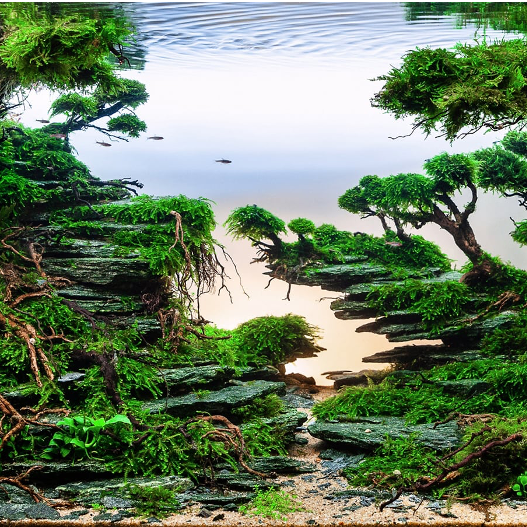
THE BASICS OF SETTING UP AN PLANTED AQUARIUM
AQUARIUM TANK
Tanks come in many shapes and sizes. The most common shape is the rectangular cube. When selecting a tank, bigger is better. Having room to grow is very important. Your plants will grow along with your interest.
Bigger tanks are easier to maintain than smaller tanks, because the bio-load is more dispersed.
SUBSTRATE
Substrate is important. A good substrate is the foundation of a thriving aquarium. A mixture of rocks, sand, smooth gravel, and aquarium planting medium will give the best results. Several plant-specific substrates are available that are infused with iron and other minerals to promote healthy plant growth. Some have the added benefit of buffering pH and softening water, both of which are desirable for many plant species.
You can also use standard aquarium sand or fine gravel and add plant nutrient tablets where needed, or layer/mix it with plant-specific substrates. Do not use coral or dolomite substrates, as they slowly dissolve and may raise pH and alkalinity above desirable levels.
WATER
All water is not the same. Only deionized water is close to pure H2O. Once it’s in your tank even that’s impure. Water testing must be done. Tap water is what most people use for their aquarium. It must be treated. There are a few different methods of treatment: deionizing, sitting, and chemical detoxification. In general, they do best in moderately soft water at a pH between 6.8 and 7.8. If your tap water is exceptionally hard or has a high pH, consider using reverse osmosis or deionized water with trace minerals and buffers added.
NUTRIENTS AND FERTILIZERS
Aquatic plants use iron, magnesium and potassium as well as other macro and micro-nutrients to grow and develop their best colors. Some plants feed primarily through their leaves, while others are root-feeders. Some plants do both. Use an enriched plant substrate when setting up your aquarium for root feeders or insert fertilizer tablets around the roots on a regular basis Root tabs are solid fertilizers and the preferred method of aquarium fertilization. They last longer than liquid fertilizers and put more nutrients were they can be absorbed by the plants. They are pushed underneath the substrate next to the roots.

LIGHT SPECTRUM
Light spectrum is important. Mix 50% antic blue light with 50% daylight or soft white. Antic blue is the color that plants thrive on. They will grow faster, bushier, and much healthier. Most bulbs are designed to emit nearly invisible light. Antic blue is a hole in our vision and is where most plant photosynthesis occurs. Daylight bulbs emit more red light which will bring out the red in fish and plants. Without red light most plants will not flower. With red light plants will grow stringer and algae will be a slightly larger problem. In soft white bulbs red colors are dulled: plants will grow bushier, and algae growth will be stunted.
The key to success with aquatic plants is using the correct light intensity and spectrum. The term “watts per gallon” is often used for choosing the best light for a planted aquarium. Watts describe how much electricity a light uses, not how much light energy it produces. While not entirely accurate, it is a useable formula with standard fluorescent lights.
AQUARIUM HARD-SCAPE
Hard-scape consists of wood, large rocks, and large pieces of décor. Most professional planted aquarium designers use natural looking hard-scapes. Using things that are obviously man made breaks the illusion of a fish world. Things that are painted should be avoided. For best results use real rocks, and real bog or root wood.
ROCK : If collecting rocks from outside choose smooth rocks and collect from the same 5 foot radius. It will look more natural. Rocks collected from sharp bends in a river will have more variation, while rocks collected from a lake shore will be more uniform. A good test to perform, that ensures that volcanic rocks aren’t going to kill your fish and plants, is to use a few drops of vinegar. If the vinegar bubbles on contact with the rock, the rock has a high pH. If nothing happens then the rock is safe.
WOOD : Collecting driftwood and root wood from outside is tricky. Conifers like pine and cedar have poisonous wood along with birch, and should never be used. Apple roots are considered the best, followed by other fruit bearing trees. Hard woods like oak, ash, and maple are excellent. All wood must be cured. It has to be dried for about a year otherwise the sap will leach toxins.
Dried wood and driftwood must be boiled to kill anything nasty they may be harboring. They should be repeatedly boiled then allowed to sit in water over a period of months, to pull out tannins. There will always be tannins but they won’t be as prevalent, and shouldn’t stain your water yellow for more than a few months. Boiling and soaking helps. If it floats it is not saturated and needs to be soaked and boiled more. When it stops floating, soak and boil it more. It’s best to buy your wood from pet stores then soak and boil it for a few days.
Tips of growing bonsai trees / bonsai driftwood for aquarium tank
Growing bonsai trees isn’t easy, and growing them in water is even trickier. Often, when bonsai trees die, it’s because their roots become waterlogged. If you’d like the effect of underwater bonsai trees without the hassle and danger, consider constructing faux bonsai aquarium plants out of other plants that thrive underwater. Driftwood can make a very attractive “trunk” to be topped with any number of aquatic plants to make for a magical and easy to care for underwater bonsai environment. Dwarf baby tears and java moss are both excellent underwater plants for creating this tree-like look.
AQUARIUM PLANTS
Plants should be placed with the tallest in the back and the shortest in the front. As a secondary consideration place the ones with more finely detailed leaves in front of the ones with more uniform patterns. Plants with large roots go in the deepest substrate. Plants with smaller roots can be planted in the rocks, crevices, and shallow substrate.
Fern, moss, and Anubias species should not have their roots buried. They do not have true roots they have rhizomes, these need to be exposed to open water. For ferns and Anubias sandwich the rhizome between to objects where you want it to grow or you could tie it to piece of hard-scape with fishing line or black cotton tread. Moss can also be tied to pieces of hard-scape.
A few easy first plants are: Horn Wort, Amazon Sword, Jungle Vale, Java Moss, Water Sprite, Java Fern, Water Lilies, and Anubias species.
How to grow aquarium plants?
– Growing aquarium plants can change an ordinary fish tank into a beautiful underwater garden. There are many different types of aquarium plants, but they all have one thing in common; they have adapted to living in a water saturated environment. They thrive with their feet wet in soggy soil and many prefer to be submerged. The different types of aquarium plants offer such a variety of shape and form. It’s entirely possible you’ll want to create an underwater garden without the fish!
– For the best and easiest care of aquarium plants, your tank should receive plenty of light. Like their surface-bound cousins, these plants need the energy produced through photosynthesis to survive and photosynthesis can’t occur without sunlight or an artificial substitute.
– Aquarium plant how-to depends a great deal on the plants involved. When choosing varieties, look for those that share common light and nutritional requirements. For instance, in such a closed and confined environment, it would be difficult to satisfy the needs of both a bright light and minimal light plant.
ANIMALS
As mentioned, fish are an accent in a planted aquarium, not the main feature. Choose species that complement the overall feel and character of the tank. Wait about a week before adding any animals. This allows the bacteria culture to develop inside the filter and the substrate. Add one fish no more than once every 3 to 4 days or until ammonia and nitrite levels are undetectable.
More active fish like to have open swimming areas where they can cruise. Instead of trying to house as many fish as possible, try to provide the best environment for a few fish. This will help with algae by reducing the amount of waste in the water. A group of smaller fish looks better than a couple big fish, by creating more activity in your tank.
When selecting animals, do your research before you buy anything, and try not to get a bunch of bottom feeders. Ideally you want fish that swim at the top and middle areas, with a bottom feeder or two. Overcrowding increases stress and aggressive behavior.


